
Sample Prompts: Pose References & Face Swaps
Great image edits start with great prompts. When you want Kira to change a specific pose, copy a pose from another photo, or swap one person's face onto another body, the prompt is what carries that intent. This guide shows the exact prompt patterns we use for three of the trickiest edit jobs: posing from a reference image, posing from a written description, and face swaps.
Each section below shows the setup, the prompt to copy, and why it works. Swap in your own subject and reference images and you're good to go.
Overview
Reference-based edits use two ingredients:
Reference image 1 — your subject. The face, outfit, lighting, and scene you want to keep.
Reference image 2 (optional) — a guide image used only for one specific thing, like a pose or a face.
The prompt's job is to tell Kira what to preserve from image 1 and what to borrow from image 2. Be explicit about both, the more you list out what should stay the same, the better Kira holds identity, outfit, and scene.
1. Pose from a Reference Image
Use this when you have a second photo whose pose you want to copy onto your subject. The reference can be anyone — a model, a stock photo, even a sketch. Kira will only take the body pose from it, not the face, outfit, or scene.
Setup
Image 1: your subject (the person whose face, outfit, and background should stay).
Image 2: a pose reference (the person whose body pose you want to copy).
Sample prompt
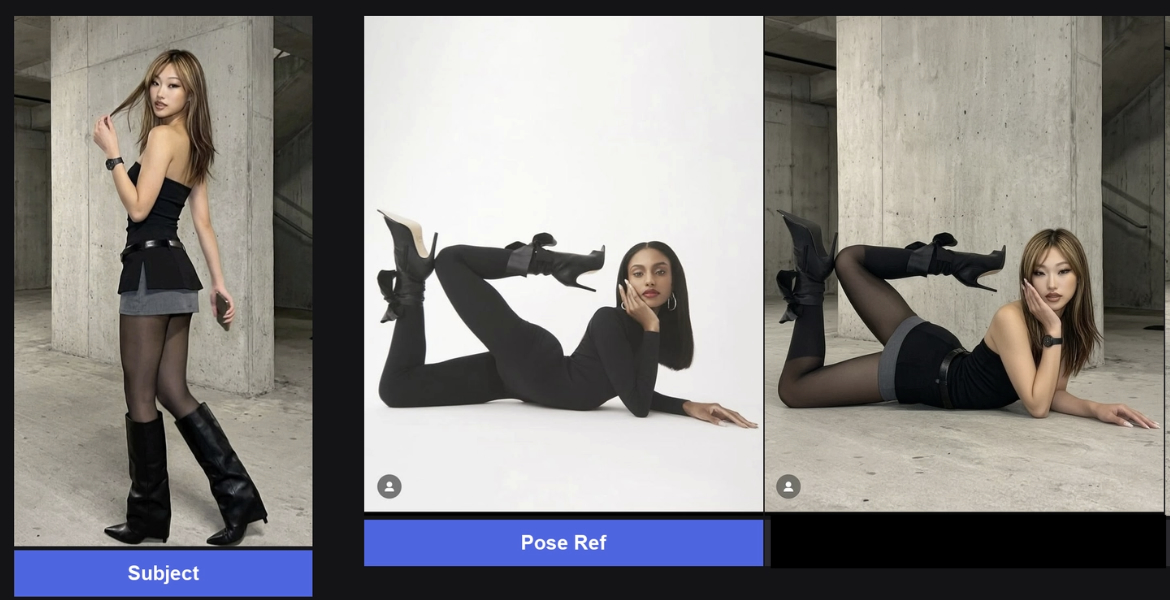
Reference image 1 is the subject. Reference image 2 is a pose reference only.
Preserve everything from reference image 1 exactly: the subject's face, hairstyle, hair color, skin tone, outfit, body shape, lighting, background, and overall scene composition. Do not change the setting or framing.
Edit pic1's subject's body pose to match the pose reference in image 2. Use reference image 2 strictly as a body-pose guide.
Why it works
The opening line assigns a role to each image so Kira knows which one is the subject and which one is the guide.
The preserve list is long on purpose — face, hair, outfit, lighting, background, framing — so Kira locks identity and scene before changing anything.
The phrase "strictly as a body-pose guide" tells Kira not to copy the reference's face, clothes, or scene by accident.
eg:
2. Pose from a Written Description
Use this when you don't have a pose reference image but you can describe the pose in words. The more precise you are about body parts, angles, and camera direction, the closer Kira will land. This pattern works great for editorial poses, expressive gestures, and choreographed shots.
Setup
Image 1: your subject. No second image needed.
Sample prompt A — Deep squat editorial pose
Reference image 1 is the subject.
Preserve everything from reference image 1 exactly: the subject's face, hairstyle, hair color, skin tone, outfit, footwear, body shape, lighting, background, and overall scene composition. Do not change the setting or framing.
Edit only the subject's body pose to the following exact pose:
The subject is in a deep low squat / full crouch. Both feet are on the ground close together, with the weight resting on the balls of the feet (heels lifted slightly off the ground if her footwear allows).
The knees are fully bent so the hips drop down toward the heels; the thighs press against the calves, and the thighs angle slightly downward away from the camera.
The body is rotated roughly 30 degrees to the camera's right, so the camera sees a 3/4 side-profile with the left side of her body facing the camera. Hips and knees point to the camera's right.
The torso is upright and elongated, shoulders level and pulled slightly back, lower back gently arched.
The head is turned over the left shoulder toward the camera, chin lifted slightly, eyes looking directly into the lens.
The left arm hangs straight down between the thighs, wrist relaxed, fingers loosely draped near or beside the left foot.
The right arm hangs naturally at the side, slightly behind the hip, hand relaxed.
Hair falls loose behind the shoulders, framing the face on the camera-facing side.
Hips low, glutes hovering just above the heels — a classic editorial deep-squat glamour pose.
Do not change anything else in the image. Face, hair, outfit, footwear, lighting, and background must remain exactly as in reference image 1.
Sample prompt B — Playful hand-on-hip with wink
Reference image 1 is the subject.
Preserve the subject's identity exactly: her face shape, facial features, eye shape, eye color, nose, mouth shape, skin tone, hairstyle, hair color, outfit, footwear, body shape, lighting, background, and overall scene composition must remain identical to reference image 1. Do not change who she is — only her body pose and her facial expression. Do not restyle or 'beautify' the face.
Edit only the subject's body pose and facial expression to the following. (Left/right below refer to the subject's own anatomical left/right, not the viewer's.)
Body pose:
The subject is standing upright, body facing the camera directly — shoulders and hips square to the lens, frontal view.
Weight is shifted slightly to her right leg with the left hip cocked a touch higher; feet are roughly hip-width apart, both planted on the ground.
The torso is upright, posture relaxed but confident, head held high.
Right arm (akimbo): the right hand rests on the right hip, fingers wrapped around the hip with the thumb pointing forward; the right elbow is bent and points outward away from the body, forming a clear triangle between the arm, torso, and waist.
Left arm (raised to face): the left arm is lifted so the upper arm extends outward and slightly upward, with the elbow bent roughly at a right angle pointing out to the side near shoulder height. The forearm rises vertically and the left hand floats up beside her face. The left hand is loosely posed — fingertips lightly grazing or hovering just below the left cheek / jawline near the temple, palm facing inward toward her face, fingers gently curled in a soft, playful gesture.
Both arms together form a symmetrical-looking silhouette: one elbow out at hip-level (right), one elbow out at shoulder-level (left).
Facial expression (keep the same face, only change the expression):
Playful flirty wink: her left eye is closed in a wink (eyelid relaxed, no squint), while her right eye remains open and looking directly into the camera with a confident gaze.
Mouth in a soft pout / cheeky smirk — lips lightly pressed together and slightly pursed forward, corners of the mouth subtly upturned on one side, as if she's teasing the viewer.
Chin tilted very slightly downward; eyebrows neutral or barely raised on the open-eye side, conveying playful confidence.
The expression should look natural and playful, not exaggerated. Skin texture, lip shape, eye shape, and all distinguishing facial features must remain unchanged — only the eyelid position (wink) and mouth shape (pout/smirk) change.
Do not alter the subject's identity, face proportions, eye color, lip shape at rest, skin tone, hairstyle, outfit, footwear, lighting, or background. Only the body pose and the described expression change.
Why it works
Each body part gets its own bullet — knees, hips, torso, head, each arm. Kira treats this as a checklist rather than a vibe.
Camera orientation and anatomical left/right are spelled out so there's no ambiguity about which way the subject is facing.
Facial expressions are described as mechanical changes (eyelid closed, lips pursed) instead of mood words like "happy" — this preserves identity while still changing the expression.
The closing line restates what not to touch, which is just as important as what to change.
3. Face Swap
Use this when you want to put one person's face and hair onto another person's body and outfit. The body image keeps everything except the head; the face image only contributes the face and hair.
Setup
Image 1: the face and hair you want to use.
Image 2: the body, outfit, pose, and scene you want to keep.
Sample prompt
Replace the face and hair in image 2 with the exact face and hair from image 1. Keep everything else in image 2 the same — same outfit, same hat, same pose, same background, same lighting.
Why it works
The instruction is short because both images carry most of the information — the prompt only needs to name the swap and the lock.
"Face and hair" is intentional. Saying just "face" sometimes leaves the original hairline visible; including hair makes the swap look natural.
The list of things to keep (outfit, hat, pose, background, lighting) prevents Kira from re-styling the body image to match the face image's environment.
General Tips for Reference Prompts
Label your images. Always say which image is the subject and which is the reference. "Reference image 1" / "Reference image 2" or "image 1" / "image 2" both work.
List what to preserve, in detail. Face, hair, outfit, footwear, lighting, background, framing. The longer the preserve list, the better Kira holds identity.
Scope the reference image. If the second image is only for pose, say so — "strictly as a body-pose guide." Otherwise Kira may borrow the scene or clothing too.
Describe anatomy mechanically. For body and face changes, use joint positions, angles, and direction words rather than mood words. "Left elbow bent at 90°" beats "arm up looking cool."
End with what not to change. Repeating the locks at the bottom of the prompt is a small move that meaningfully improves identity preservation.
Copy-Paste Starters
Skeleton prompts you can adapt with one search and replace:
Pose from a reference image
Reference image 1 is the subject. Reference image 2 is a pose reference only. Preserve everything from reference image 1 exactly: face, hairstyle, hair color, skin tone, outfit, body shape, lighting, background, and overall scene composition. Edit the subject's body pose to match the pose reference in image 2. Use reference image 2 strictly as a body-pose guide.
Pose from a written description
Reference image 1 is the subject. Preserve face, hair, outfit, footwear, body shape, lighting, background, and framing exactly. Edit only the subject's body pose to: [your pose description, broken down body part by body part]. Do not change anything else.
Face swap
Replace the face and hair in image 2 with the exact face and hair from image 1. Keep everything else in image 2 the same — same outfit, same pose, same background, same lighting.